

Sciatica
Sciatica is sometimes diagnosed, but actually it is not a diagnosis but a symptom: pain in the leg that radiates in a specific way from the back. On this page, we describe what sciatica is, what the causes are, and what you can best do about it.
What is sciatica?
Sciatica is pain in the leg caused by compression of the large leg nerve, the sciatic nerve. The pain follows the path of this nerve, but the degree of radiation varies. It can pull the leg a little from the back, but also all the way to the foot or somewhere halfway. The pain is usually sharp and burning. It can lead to loss of strength and muscle failure, causing a foot drop. The foot can then no longer be lifted.

Causes of sciatica
The large leg nerve can be compressed in different places and for different reasons. The main causes are:
Hernia
The most common cause is a herniated disc. Due to a damaged intervertebral disc, a bulge can form that pinches the root of the large leg nerve.

Of all patients with a herniated disc and radiating leg pain, three-quarters recover within three months, and about 10 percent have chronic complaints. Read more in our detailed article about Hernia and Lumbago.
Narrowing of the foramen
The foramen is the space between two vertebrae where the nerve exits the spinal column. If the foramen is narrowed (foraminal stenosis), the nerve can be compressed.

The foramen: left normal, right narrowed (foraminal stenosis)

A normal foramen with the nerve root inside. The smaller the foramen, the faster the nerve root gets pinched.
Stenosis in the spinal canal
Due to bone growth, which mainly occurs in older people, the passage of nerves on the side of the spinal canal - which lies a few centimeters deeper than the foramen - can be obstructed.
Bulging intervertebral disc
An intervertebral disc (discus) can also bulge somewhat if it is not torn. An example of this is a ‘bulging disc’. Combinations also occur regularly. A naturally small foramen combined with a bulging disc or some bone growth, for example.
Inflammation, abscess, metastasis
The passage of a nerve can also be obstructed in various places by a condition that locally takes up space, such as inflammation, abscess, or tumor. This is rare.
Piriformis syndrome
Some authors describe that the large leg nerve can also be compressed by a narrow passage along the deep gluteal muscles. One of these muscles, the piriformis, is held responsible by some authors. Whether this really occurs and to what extent is still unclear.
What is the best treatment?
This cannot be said without further examination. It entirely depends on the cause of the sciatica. And even if the cause and exact location of the compression are known - such as with a hernia - it is not yet possible to say in advance what is best. In about 80% of those cases, a hernia recovers naturally within 3 months, while 10% of cases have chronic complaints. If you know in advance that you are in that 90%, it is best to wait. If you knew beforehand that you are in the 10% with chronic complaints, it is best to have surgery as soon as possible (if possible). The problem is that you do not know in advance which category you will fall into.
Wise policy:
- Wait calmly unless there is unbearable pain or paralysis symptoms
- Keep the back moving but do not force it: walk a lot, spread out regularly over the day
- Do not sit for too long at a time and certainly not with a curved back
- Adjust the sleeping position so that the back is not twisted at night. The Mikoala Body Pillow can help with this.
For more tips:
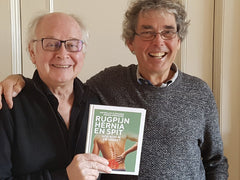
- Read the book Back Pain, Hernia and Lumbago. How do I get rid of it? It contains many more tips to recover quickly and prevent worsening
- Do the ipel test described in this book, or watch this video
- Do the ‘end position exercises’ from this book if the ipel test is positive
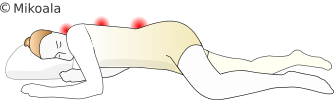

Recovery from sciatica
Whether the cause of sciatica lies in a narrowing of the foramen, a hernia, or another cause: if the lower back is not twisted, this reduces irritation, improves sleep, and promotes better recovery. For more info, read ‘complaints caused by sleeping’
Read more about sciatica, hernia, lumbago, treatment, exercises, surgical options, prevention possibilities, and much more in the book Back Pain, Hernia and Lumbago. How do I get rid of it?
Authors:
- Menno Iprenburg, retired orthopedic surgeon and founder of the Hernia Clinic Veenhuizen.
- Drs. Jan Willem Elkhuizen, physiotherapist, manual therapist, and movement scientist, co-founder of the website Ligwijzer.nl
©2026, Jan Willem Elkhuizen, physiotherapist and movement scientist