


Hernia
- What is a Hernia?
- What is Spit?
- What is the difference between hernia and lumbago?
- Causes of hernia and spit
- 6 Tips for recovery and prevention
- Improve your sleeping posture with the Sleep Better Set from Mikoala
-
Conclusion
Hernia and spit are conditions that cause severe back pain and sometimes leg pain. They can be so similar that a general practitioner cannot make a diagnosis.
Both conditions share a common cause, where ‘internal leaks’ in the intervertebral disc play an important role. These leaks can often be reduced with special exercises. This promotes recovery and prevents recurrences.
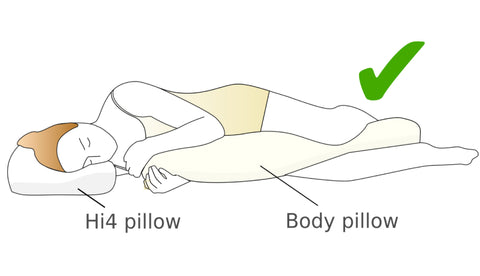
It also helps to sleep with a body pillow. The back then does not twist, and the tension in the back decreases. This promotes recovery.
We conclude with more practical tips to recover as quickly as possible. Go directly to our tips for recovery and prevention
What is a Hernia?
Hernia literally means 'rupture' or 'bulge'. In a spinal hernia, both are involved: there is a rupture (tear) in the so-called intervertebral disc (discus) and there is a bulge. Most hernias are located in the lower back.

In a hernia, the disc is damaged: the core content can escape outside the disc. This is caused by a tear in the fiber layer surrounding the core (the annulus).

From above, it looks like this (cross-section):

The tearing process
The annulus consists of about 20 layers of thin lamellae (less than half a millimeter thick). Thousands of strong fibers are embedded within them.

Normally, the core content cannot penetrate through the lamellae, but they can become leaky. There is a hernia when all lamellae are leaky and the core content has escaped outside the disc. This is a process. First, part of the lamellae tears, then another part, and so on. It can take years before all lamellae are torn and a hernia develops.

What is Spit?
Spit is also called ‘throwing out your back’. The pain shoots in the back, the muscles become hard, and the back locks up, making it difficult to move properly. Often, you also cannot stand up straight anymore.
Explanation
The fibers in the annulus are made of the same material as the ligaments (collagen connective tissue). Every time fibers tear, you experience the same symptoms as with a torn ankle ligament: sudden pain, a lot of stiffness, and inability to bear weight.

By massively tensing muscles, extra damage is prevented. This reaction is known as ‘defense musculaire’ and as 'bracing'. Lumbago thus seems like a muscle problem, but the real problem lies in the disc.
Important
Only the acute phase after fibers tear is called lumbago. If the complaints do not completely disappear after a few months, it is simply called 'back pain'.
A next lumbago attack is often more painful than the previous one. This is because the annulus contains many more nerves on the outside. The further the tear extends in the annulus from inside to outside, the more painful it becomes.
What is the difference between hernia and lumbago?
As long as the last lamella remains intact and only fibers tear in the inner lamellae, it is called lumbago. A hernia occurs at the moment the last lamella breaks through and the core content ends up outside the disc.
There is another difference: the core content that has come out of the disc can compress nerves. This often involves the large sciatic nerve and can cause sharp pain in the leg.
Many patients have had lumbago in the years before their hernia. This is often not recognized as part of the process that can lead to a hernia. Later, a hernia then ‘just’ occurs.
Need more explanation? Then watch our explanation videos.
Causes of hernia and lumbago
The fibers in the disc do not tear easily. A weakening of the disc precedes this. Broadly speaking, this is what happens:
- Incorrect use of the back leads to small leakages in the annulus
- These leakages cause extra tension in the fibers
- A ‘wrong movement’ is the final push that causes these fibers to tear (you throw out your back)
1. Incorrect use of the back leads to micro-leakages
The disc stays healthy if it moves a lot and in varied ways without overloading. Walking a lot is very good for the disc. Sitting a lot is actually bad, especially if you sit with a rounded back. This reduces flexibility and the number of cells in the disc.

Slouching on the couch with a rounded back puts strain on the disc.
Frequent bending by people who are not used to it is another risk. An incorrect sleeping position can also play a role: if the back or neck is twisted, stiffness can develop.

Incorrect use of the back causes leakages of core content into the annulus, without fibers tearing directly.
The core content is essentially pressed through the fibers. A kind of ‘pathway’ forms. This creates a weak spot and increases the chance of tears.

Micro-leakages: core content leaks between the fibers (Tampier, 2007)
2. Micro-leaks cause extra tension in fibers
The leak does not just pass through the lamellae; force is needed for that. If the wrong movement stops, the leak does not continue. As soon as the wrong movement continues, the leaking continues. The pressure from the leak on the adjacent fibers causes extra tension in those fibers.

The tension in the fibers next to the leak is greater than in other fibers.
Isotony
Normally, the tension in all fibers is equal (isotony). This makes the disc strong and the chance of tears small. Due to the leaks, the tension in some fibers increases, making precisely these fibers vulnerable.
3. A ‘wrong movement’ is the final push
Once the strongest man in the Netherlands threw out his back while sitting on the couch and reaching for something on the table.
By ‘hanging on the couch’ micro-leakage can occur and the tension in some fibers increases. Bending and twisting (reaching) is then the last straw that breaks the camel’s back. The fibers with the most pre-tension give way first.
This is the classic combination to throw out your back: extra tension in fibers + bending + twisting.
This happens, for example, when digging in the garden. It is no coincidence that this condition got the name ‘Lumbago’!
6 tips for recovery and prevention of hernia and lumbago
-
Improve your sleeping position: do not sleep too long in a twisted back or neck position. A body pillow can help with this, see the article about the sleeping position. Research showed that the pain then decreases as well as the number of days with pain.
- Reducing leaks*: By doing special exercises, it is usually possible to reduce leaks. This can quickly alleviate complaints. How to do this can be read in the book 'Back Pain, Hernia and Lumbago. How do I get rid of it?' or you can watch this video.
- Listen to body signals: before fibers tear, there are usually warning signs. Such as a tired feeling in the back, stiffness, or pain. Take this seriously: be careful and do the exercises.
- Don’t sit for long periods: alternate sitting, standing, and walking.
- Walk a lot: walk several times a day, preferably about 3 times and for a total of an hour or more per day
- Prevent going through your back again: in addition to the measures mentioned above, there are many more prevention options. See the book 'Back Pain, Hernia and Lumbago. How Do I Get Rid of It?'.
Explanatory videos about hernia and lumbago
Conclusion
Hernia and lumbago are closely related. The anatomical event is largely the same: collagen fibers tear. This does not happen ‘just like that’; often long-term processes precede it, such as leakage of core material into the annulus. In many cases, these leaks can be reduced. To recover quickly and prevent recurrences, it is important to reduce these leaks as soon as possible with the help of special exercises.
Accountability
- The information on this page comes from the book 'Back Pain, Hernia and Lumbago, How Do I Get Rid of It?', co-written by the founder of Ligwijzer.nl, Jan Willem Elkhuizen.
- Reducing leaks is hardly known among doctors and therapists. However, it has been demonstrated both with laboratory research (Scannel, Spine 2009) and experimental research (Gherscovici, Presentation World Congress of Low Back Pain, Dubai 2013).
- Download the detailed summary of the book to read it again later.
- In the book “Back Pain, Hernia and Lumbago. How Do I Get Rid of It?”, the authors Jan Willem Elkhuizen and Menno Iprenburg discuss this extensively. After publishing their book, they developed a test to detect leaks: the Ipeltest.
©2026, Jan Willem Elkhuizen
