

Recovering from a Hernia
What is a hernia?
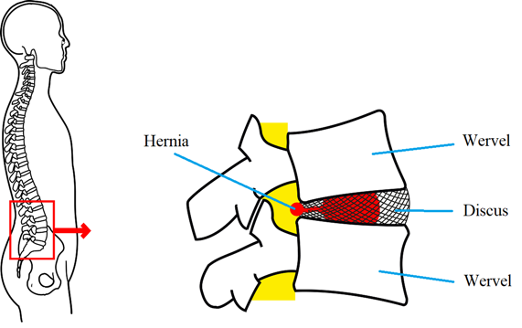
A hernia is the result of a tear in an intervertebral disc (disc). That disc consists of a core of liquid material with a ring of fibers around it. In a hernia, the core content protrudes outside the disc. This bulge (hernia) can press on a nerve, causing a lot of pain and sometimes even paralysis.

How do you recover fastest from a hernia?
The torn fibers can heal naturally, just like a torn ankle ligament. It takes time, but you can influence the process.
Compare the recovery to an open wound in the skin: if the edges are close together with a bandage, recovery goes smoothly. If there is a lot of space between, it can take a long time.
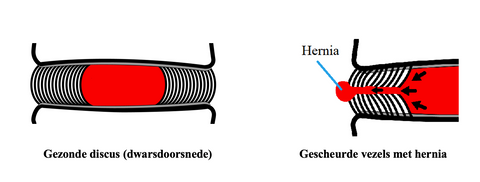
In the right image, the edges of the torn fibers are held apart by the core content in between. The goal is to guide this back to the core. Only then can a hernia heal optimally.
Basis for recovery
1. Push the core content back to the center
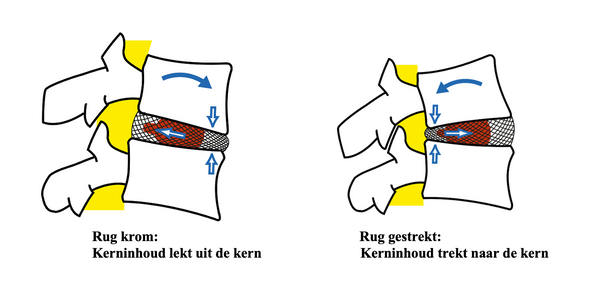
2. Keep the ‘leak’ closed by keeping the back straight
When standing upright, the back is in a slightly hollow position. With each push-off, the back stretches even more. This has a beneficial effect on the leakage in the fiber layer: it is pushed back toward the core.
Tips for recovering from a hernia
- Walk regularly and build it up gradually.
- Sit as little as possible, stay active as much as you can.
- If you do sit for a moment, use a support behind your back (arched back).
- Avoid bending, keep the back stretched (as arched as possible).
- If the back becomes too painful: lie down on the couch for a while.
- If you lie on your side, place a body pillow between your knees and a support behind your back.
- If you lie on your back, place a pillow under your knees.
- Sit upright, with your hands on your back. Arch your back as much as possible. You can do this as often as you want, as long as there is no pain radiating to the buttock or leg.
By avoiding bending, not sitting too much, and not slouching on the couch, you prevent the nucleus from leaking and getting between the fibers. The less nucleus between the fibers, the better the recovery. These tips also apply to recovering from hernia surgery. Always consult your doctor.
How do you sleep best with a hernia?
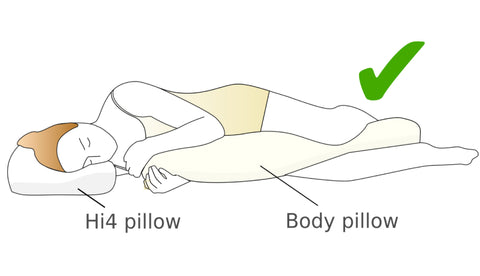
This is the best sleeping position to recover from a hernia.
- The back is not twisted
- The back is straight
- The back is relaxed
- The neck is also not twisted, but straight and relaxed
In this position, there are no unnecessary stimuli. You need to turn less often. This creates calm and relaxation so your back can recover fastest.
More articles:
GezondNU research report
1e publication GezondNU
2e publication GezondNU
Tension headache
Neck pain
Back pain
©2026, Jan Willem Elkhuizen